
A single night of heavy rain and rushing water left an impact that the Texas Hill Country will remember for many more. On July 4, remnants of a tropical cyclone that formed in the southwestern Gulf of Mexico battered Central Texas, leaving a devastating impact in a single night of heavy rain of rushing water. Overwhelming Kerr County, a flood-prone area, the storm caused a record-breaking rise of water that destroyed hundreds of homes.
The Guadalupe River rose between 16 and 37 feet in some areas, according to U.S. Geological Survey water gauge data. PBS reported that 135 people died, leading Texas residents and organizations to undertake widespread efforts to restore the towns and communities affected.
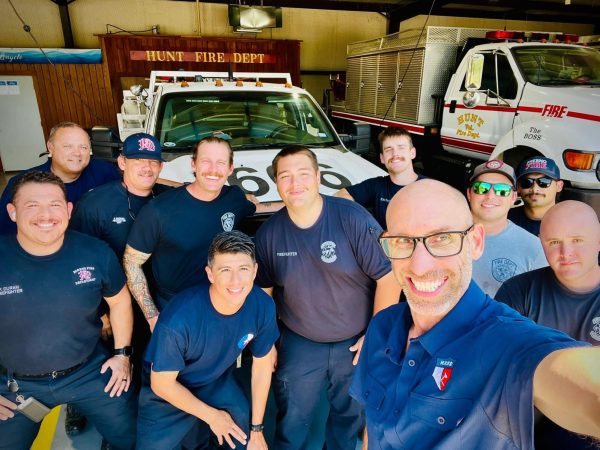
Lee Pool, the Volunteer Fire Department Chief in Hunt, Texas, explained that the floods came extremely fast. Because of their timing, people in towns along the Guadalupe River were trapped by rising water before they could react.
“I got called out at 3:37 in the morning to assist a family of five that was trapped on a roof,” Pool said. “I was calling my wife and assuring her that I’m going to be okay.”
The following day, the waters receded, allowing rescue services to enter. That morning, he began his work.
“Initially, when the water went down, the closest residents were on the river closest to us that we had access to,” Pool said. “That’s when we started our search and recovery efforts. We did find victims, we removed those bodies from the areas, so that way, justices of the peace (local judicial officers) and the coroners could come through and pick them up, but later, when the waters did go down, we had to establish an incident command system at our fire station.”
Immediately after the flood, first responders were blocked by the obstruction of key routes into towns. Currents destroyed roads, and wood and debris blocked the limited number of entrances into the small towns that were hit.
“Shoemaker Crossing, that’s really the only way into Hunt,” Pool said. “We had to wait for the water to go down for that and then remove the debris from that bridge, make sure that it was structurally sound, and still had integrity because we were going to be driving heavy equipment across it.”
Because access to so many areas was blocked, Pool’s emergency coordination included heavy machinery. After they had cleared the roads, they were able to send in smaller units, although by then the object of their efforts had shifted.
“Excavators, skid steers, those pieces of equipment were used to move debris,” Pool said. “So that way, cadaver dogs, cadaver sniffing horses, could come and do their job.”
Along with search and rescue, volunteers helped clear debris and look for victims, one of whom was Jacob Mattern. Originally from Boerne, a town southeast of Kerrville that escaped the scope of the floods, Mattern had visited Kerr County in his childhood, and he felt the disaster hit close to home.
“I don’t think a lot of people really knew what all was going on or how serious it was initially,” Mattern said. “It’d been multiple days since the flood had gone through there. And there were just still so many people that they said were still missing.”
Although the Texas Hill Country is familiar with flooding, this magnitude of flooding was unexpected, and there were few flood-warning systems to abate its suddenness. Pool recalled markers like the Dam Store area in Ingram being completely submerged for the first time.
“I’ve heard stories about the other 1979 flood and how it got up into that area, and it’s unfathomable,” Pool said. “Like, ‘I’ll never see that’. We saw it on July the 4th of 2025, and it was even bigger than that.”
After the strength of the Guadalupe River took many by surprise, search and rescue efforts after the initial emergency response grew grim. When the storm woke locals, it was often because waters had risen to such an extent that they surrounded them, leaving little opportunity for escape.
“It had been a recovery operation, from my understanding, since that Monday,” Mattern said. “I don’t think that they even found anyone alive after Saturday. They were sending people out to go see if any more bodies could be recovered.”
The sudden damage and loss of life shocked communities. The Guadalupe River’s calmness often attracted swimmers from nearby areas, including those in summer camps at the time of the flood, making the chaos more heartbreaking, according to Mattern.
“I mean, it was crazy,” Mattern said. “When we got down closer to the river, you’d look up and there would be these objects way high up in these cypress trees. And it’s hard to describe how surreal it was there in the aftermath of it and the feeling of the sheer height of water that washed over the river. It was really sad.”
According to Justine Shih, an employee at the Austin Disaster Relief Network (ADRN), long-term recovery efforts are continuing to help the area rebuild. Her organization has coordinated restoration and cleanup efforts in the area.
“We’ve been able to deploy thousands of volunteers to help with cleanup efforts and physical relief, which is still active,” Shih said. “We’ve been assembling hygiene kits and cleanup buckets, which allow families to have basic essentials and regain their dignity after a disaster.”
Organizations like ADRN provide help to those affected from the big things to the small. With the homes and communities of many having been destroyed, Shih pointed out that sometimes it’s the small things that can give people the most support.
“It tells them that someone is there, someone cares for them,” Shih said. “All these are helping to build a foundation for long-term recovery, which is like helping with home repairs, helping with emotional and spiritual care as they recover in that way from the disaster and just continue to walk with them as they rebuild their lives.”
Although the tragedy of young lives cut short at first jarred Central Texans, Pool observed that it ended up uniting them, with people like Mattern coming to help out their community in a time of need. To help with flood recovery from a distance, people can donate to organizations like ADRN and Community for the Hill Country.
“Our community stepped up and showed compassion, and everyone wanted to pitch in and help those that were in need,” Pool said. “We heard stories about people who didn’t have homes that were affected, that were taking entire families into their homes and allowing them to shower and sleep and fellowship with each other. Out of complete darkness, there was light shining.”