
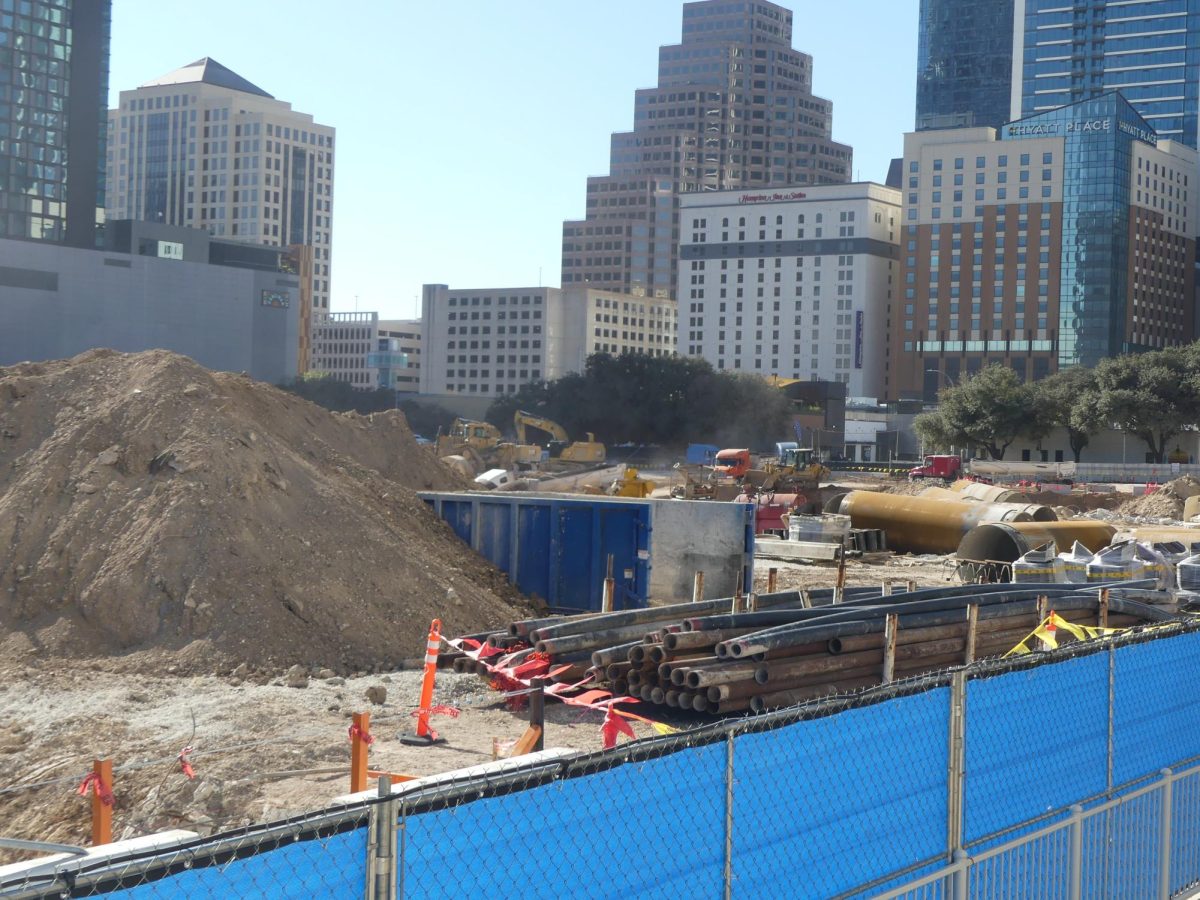
Business meetings, high school dances, basketball games: all of them had to leave the Austin Convention Center this September as wrecking balls and CAT trucks took their place.
Austin City Council voted this July to bring down the original center to make way for a larger, more robust building downtown. The idea has been in the works since 2015, when the Austin Convention Center Department hired a consulting firm to draft an analysis of potential expansions into the surrounding blocks. After negotiations with property owners surrounding the six-block center failed, iterations turned to an internal plan, expanding up and down without increasing the facility’s footprint. Throughout this decade of discussions, however, Acting Deputy Director Katy Zamesnik said the goal has remained accommodating more action.
“We were turning away about 50% of the business leads that we were receiving,” Zamesnik said. “That was simply because we were either too small for that event, or because we were already booked. We are the 61st largest convention center in the country, even though we’re the 13th largest city.”
The new structure will allow 200,000 square feet of more space for events with an underground exhibit hall, outdoor public plazas, and cultural exhibits. Opening in 2028, it is estimated to bring an annual $285 million more economic impact than the previous average of $550 million.
“Since we announced the expansion in 2015, 37 hotels have opened up downtown in anticipation of that,” Zamesnik said. “We knew that tearing the building down, starting fresh, being able to put all of our civic halls underground was really the right thing to do for the project. And that was what we worked on throughout the COVID period.”
To pay for the construction, City Council created a Convention Center operating fund, which draws from Hotel Occupancy Tax (HOT). HOT charges short-term bookings an additional 17% of the room’s cost, typically ending up on the customers’ bills, of which 6% goes to the state of Texas. The City of Austin splits the remaining 11% it levies into 2% for UnconventionalATX, the expansion project, and 9% for other tourism affairs. 15% of the money going to UnconventionalATX is directed to cultural arts, and another 15% of it is put aside for historical preservation.
“If there’s no expansion, there is no 2% expansion HOT, and then therefore there is no funding for live music,” Zamesnik said. “Tourism is the fourth largest employer here in Austin, and we’re a really critical part of that. I think we would lose out on a lot of what is really important to Austin, since the live music fund is funded from the Convention Center’s operating fund.”
Although HOT money will pay for the bulk of the project, as well as live music, the July budget included additional city funds. This has drawn the ire of the environmentalist Austin United PAC, which spokesperson Finn Sonniksen explained had drawn up a petition against the plan due to what he called its shortsightedness.
“We held petition events all over the city, trying to get as many petitions as we could from certified, valid voters on the voter roll,” Sonniksen said. “I think that the ideal would’ve been for them to consult people in Austin about what we want to do with the convention center.”
Although there was no direct input on the latest plan, city officials did take efforts to include Austinites’ voices. An initial 2019 vote prompted Austinites to consider whether voter approval should be required for expensive convention center improvements and increased HOT, and one of the committees assigned to analyzing the possibility of expansion was composed of private citizens. Because the vote failed, City Council has been able to shape the plan, and implemented the raised HOT to meet it.
“The visitor impact task force was appointed by City Council, and they worked for about a year to study the idea of an expansion and whether or not it was something that we should do,” Zamesnik said. “They published their report and supported unanimously that we should go ahead and do an expansion… We also have the Tourism Commission, which is another citizen-led appointed body, and they were sent up after the task force to advise the council on matters related not only to expansion, but to Hotel Occupancy Tax.”
While the construction would be paid for with the operating fund, Austin United PAC treasurer Tanya Payne worries the city could dip into its primary budget to cover unforeseen costs.
“This council is like, ‘Oh, it’s all Hotel Occupancy Tax, but don’t look while we approve another loan,’” Payne said. “Before this, they had said it’s already paid for, it’s all Hotel Occupancy Tax, and it’s on time and under budget. And then all of a sudden, there was a need for more money, and they just quietly voted for it.”
The city rejected Austin United’s petition after eliminating 483 signatures in a sample of the 21,000 they collected, putting them just under the 20,000 needed to trigger a citywide vote, two of which they attributed to duplication. The unknown cause for rejecting the remaining 481, described by the city as “miscellaneous reasons”, worries Payne.
“We bought software, we had validators, we touched each and every one of those signatures,” Payne said. “They don’t want us to vote on it. In light of Prop Q, people are really aware that this Council has been on a spending spree.”