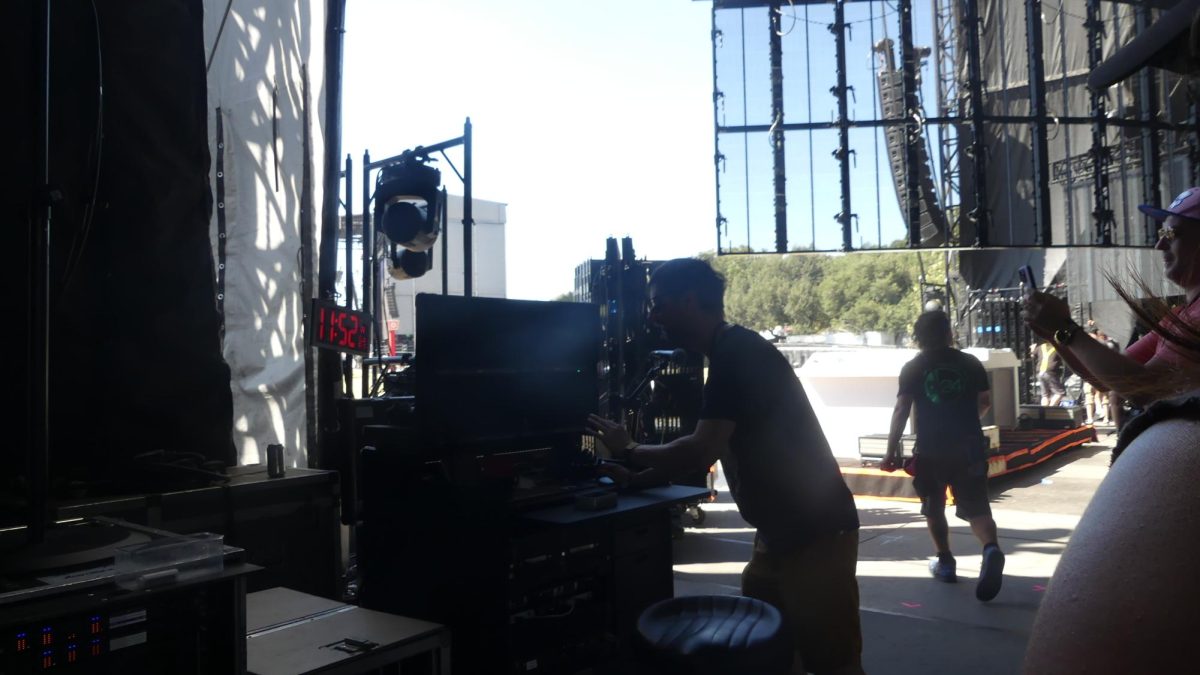

On the big stages of Austin City Limits, artists have many pieces of their music, from their voice and guitars to drums and bass that come together to form their signature sounds. Behind the scenes, or in big tents in front of the stage, audio technicians are key to making sure that all these vastly different pieces come together in just the right way to make an amazing sound for the audience.
Austin City Limits (ACL) has two main stages and six other smaller ones, each with its own group of sound people to ensure smooth performances. They do a sound check at each stage once every day, mix the audio for both the speakers and monitors throughout the performances, and fix the multitude of problems that arise throughout the day. Ben Foster, an employee of Big House Sound and live audio engineer on the BMI stage, described all of the planning that goes into getting ready for the festival.
“There’s a lot of email advances depending on what artists might need.” Foster said. “We all have a particular stage package for our stages, and then, if there’s any extra gear that artists might need, they would sort that out in advance through email.”
Audio technicians also have to ensure that they are ready before the show to ensure that it runs smoothly. One tool that is an essential part for Polo & Pan is Ableton: a music production platform allowing for live production, arrangement, and much more. Nicolas Miossec, the Ableton operator for Polo & Pan, is tasked with ensuring that everything is ready to go before the show.
“We’re well prepared now, so it’s not overwhelming,” Miossec said. “I can check things in advance if I have any doubt on the station, on some modification we want to have from one show to another. This can be so we can improve instruments, the mixing, sometimes we have to make a little change in the set list.”
The sound check before the festival starts is the only opportunity, according to Foster, for the sound people to make drastic changes to the sound. After that, they are only able to make sure that the levels are set and the musicians have everything they need.
“The first sound check of the day is really good for me to get a starting point for the whole day,” Foster said. “And then the main stage hits, so we can’t really do a full sound check, so it’s just through headphones.”
There is only a short amount of time that the sound people get to complete their full sound check. Brieuc Labiouse, the sound engineer for Polo & Pan, compared this to the amount of time they usually have to get ready for a performance.
“We have much less time than usual, so we have to be on our best to make it work,” Labiouse said. “Usually we have all day, we start at 10:00 a.m. and the sound check is at 4:00 p.m. Today we started at 8:30 a.m., and the sound check was at 11:00 a.m., so it’s much shorter.”
There are two important parts of running sound for a stage and communication between people is a must. Foster described that these parts depend on where one is during the festival.
“I have this radio here, this festival provided radio,” Foster said “We have a dedicated channel for our stage with my stage manager and the monitor engineer, who’s mixing the sound for the bands on stage, whereas I’m just focused on the front of house for the audience’s sound.”
According to Juno Black, who is an employee of Big House Sound and helps with the sound on the BMI Stage, the backstage crew is just as important as the front of house sound people in ensuring that the festival sounds great. Black described some differences between being backstage and being in the front of house.
“We’re more concerned with managing all of the audio systems on the stage,” Black said. “The main objective is to have the artist comfortable so they can play their show. We’re focused on the artists, not so much on the audience or what’s going on outside.”
Since the festival is so hot, there are a lot of problems that can arise. One of the main problems is equipment overheating, and according to Foster, most of the devices across the stage are susceptible to this problem.
“After day one, I went and bought this umbrella, this sun reflective umbrella, and I’m just moving it around as the sun moves to protect my console.” Foster said, “Sometimes with the heat, the amps that power the speakers will start to give me temperature warnings. Then I’ll take a fan down under the stage and put it on the amps. Even though it’s not in direct sunlight, it’s still accumulating heat from being under there.”
Although technology is a very important part of their job, sound people also help with shaping the sound that the audience hears from the artist. Black added that this is an art that takes a lot of time to master.
“You have to shape each one of the sounds that you’re getting, so they are very distinguishable from other sounds and everything can be heard, “ Black said. “So you’re shaping, you’re feeling and limiting the dynamic range of the sounds, how loud and soft they are in order to make the sound.”
The sound engineering that they do is not just important for the enjoyment of the audience, but also for the safety. Foster added that being able to do this is as much of an art as shaping the sounds.
“You wouldn’t want to damage anyone’s hearing, whether it be an artist or an audience member,” Foster said. “So just being able to tame a sound to where it’s not harmful to hear is important.”