With two weekends of live music, notable bands from around the world, and tens of thousands of partying attendees, ACL is a feast for the ears. But while the focus of the festival may seem auditory, deaf guests have found a way to enjoy the show in their own way as well.
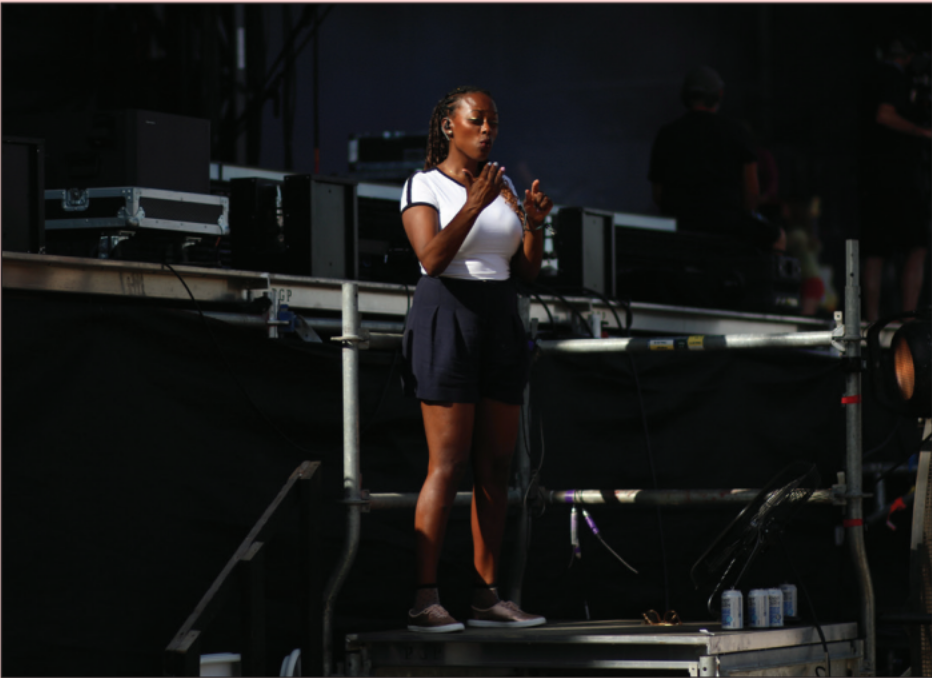
Since 2012, ACL has offered American Sign Language (ASL) interpretation services. Attendees can request them for specific shows in advance, and then they receive an area near the stage to watch an interpreter sign and dance to the music
Amanda and David Tuite have been active in the Deaf community in a myriad of ways. Amanda serves as president of the Texas School for the Deaf Foundation and CEO of her company, Access Vine. The married couple started working at ACL four years ago, and they manage the interpreting operations.
“We work together on creating a team for ASL accessibility,” Amanda Tuite said. “We create a team to be assigned to the stages to allow the deaf and hard of hearing to be in the pit.”
Amber G Productions is the brainchild of the San Antonio performer Amber Galloway. The deal with Galloway is part of a larger effort by ACL to give people with disabilities the chance to enjoy the festival, making it more accessible for customers who need accommodations for mobility impairment, special dietary needs, or deafness.
“It’s a big deal to have Amber G Productions as part of ACL,” Amanda Tuite said. “Many deaf people know that they will have high quality interpreters. When they find out that she is responsible for the acts, it’s really huge for the community.”
As performers, her ASL interpreters, who are trained and qualified, do more than translate song lyrics. They give viewers the chance to feel the rhythm and instrumentation of the music through dancing and facial expressions.
“A very small group of interpreters can be experts in this,” Amanda Tuite said. “You have to have the musicality, you have to have verse rhythm to match and move along with the beat. You have to have a musical background to understand what kind of instruments are being played because you’re showing different instruments.”
David Tuite explained that because ASL is a distinct language, English phrases can’t be translated directly. Instead, performers focus on getting the artist’s message across.
“For example, ‘take me for what I am’ is not signing ‘take me for what I am,’” David Tuite said. “It’s more like, ‘take me as I am.’ which is very different. We’re not signing word for word. We’re taking that whole thing and signing it as a concept at the same time as the person with the microphone.”
Susan Gillespie coordinates the deaf seating area, communicating between the stage crew and deaf guests to set them up near the interpreter. She emphasized the work that goes into preparation for live events.
“The interpreters have to prepare three months back, and they contact the performer so the interpreter can prepare and look at the words,” Gillespie said. “That way, they can fully understand the words, and it’s awesome.”
Live performances can sometimes mean the artist going off script with impromptu lyrics or greetings, forcing interpreters to adapt on the spot. This can be more difficult for those who are fully deaf, but Amanda Tuite described that they remain well-received.
“We have Deaf interpreters and we also have hearing interpreters,” Amanda Tuite said. “Deaf people in the audience will sometimes request a Deaf interpreter. On the stage, the Deaf interpreters already have that culture engaged in them.”
This style, which emerged in the last decade as venues seeking out inclusivity began interpreting performances, has become popular among the non-deaf as well. Videos of the most talented professionals, who are able to seamlessly incorporate signs of what the artists are saying and doing into their dances, have gained the profession attention online. Still, Amanda Tuite thinks the work could use more attention from within the community since many deaf people are unaware of its presence.
“They could do so several different ways,” Amanda Tuite said. “Write an article in the paper, do a news interview on TV in ACL with Amber about her experience or interview an advocate. Inform the community. Say, ‘hey, come on over, you can get sign language interpreters here.’ Many people react, ‘I didn’t know that was an option.’”
For a performance to be interpreted, attendees must fill out a request form for the intended timeslot. David Tuite worried that deaf aren’t aware of the opportunity and miss the window to request the service in advance.
“Most Deaf people don’t know about their responsibility to request an interpreter,” David Tuite said. “They’re missing an opportunity to get the actors they need.”