

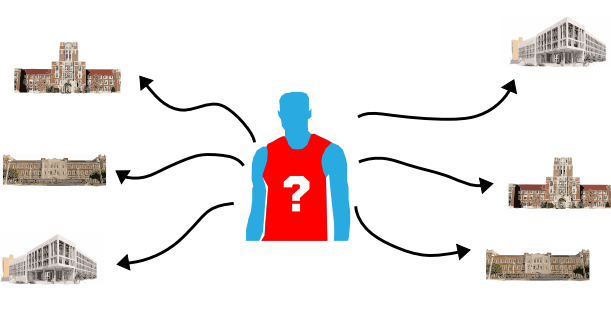
When I first heard about the college sports transfer portal, I thought it sounded like freedom: real freedom. The kind athletes rarely have, and at first, it felt empowering. If a school wasn’t the right fit, you could move on. If you weren’t getting playing time, you could find a place that believed in you. But as I paid more attention, I realized the portal isn’t just a helpful door: it was the kind of freedom athletes needed.
The transfer portal was made by the National Collegiate Athletic Association (NCAA) for the athletes. The portal allows athletes to change schools without having to sit out a year, which, in theory, is good for the athlete because they work very hard and deserve to be in a place where they feel wanted. My swim coach, Ben Sampson, once moved from Colorado Mesa swimming to Texas swimming. It was a huge opportunity for him as the transfer meant he had access to better facilities, higher competition, and more exposure. Seeing this made me understand something important: coaches have always been able to look for better situations. So, why shouldn’t the athlete have the same opportunity?
This is why I don’t think the portal is automatically bad. In fact, some of the biggest success stories in college sports have been due to the portal. Joe Burrow went from being unable to get playing time at Ohio State to becoming a legend at Louisiana State University, leading his team to a national championship. In women’s basketball, players like Haily Van Lith have used the portal to grow their careers and play at higher levels. These aren’t just lucky stories — they show what can happen when athletes are finally placed in situations that fit their skills and confidence.
However, my feelings start to change because what looks like freedom also creates chaos. Teams don’t feel like families anymore. They feel temporary. One year you develop chemistry, trust, and bonds, and the next year half of your team is gone. Iowa State, for example, just came off a winning season, and because of the transfer portal, they lost an astonishing 55 players according to Sports Illustrated. The players are always wondering who is going to leave next and if they should leave too. That constant uncertainty messes with team spirit and loyalty. College sports used to be about growing together over time. Now, it often feels like everyone is just passing through.
And the pressure doesn’t stop at college athletes. High school players are feeling it, too. Now a transfer with experience is sought out by colleges instead of taking a chance on an inexperienced freshman. This leaves fewer scholarships available for a student coming in from high school who has worked hard their whole life in high school, dreaming of playing at the next level. The portal may help current college athletes, but it quietly shuts doors for younger ones, according to Sports Illustrated.
Another hard truth is that not everyone wins in the portal. For every Joe Burrow, dozens of athletes enter thinking life will improve and end up with no offers at all. Some lose their roster spot and never recover. Others transfer multiple times, fall behind in school, and lose stability. It becomes a gamble with their future, not just their playing time.
The academic side worries me too. At its core, college is supposed to be a place for education, but switching schools can mess up credits and delay graduation. When athletes bounce from school to school, it makes it seem as though school is not even part of the equation, but rather an afterthought.
My primary concern, however, is how it seems as though college sports are becoming a form of professional free agency. The bigger schools, which have more resources and media attention, continue to take top recruits from smaller schools every year. It is becoming difficult for fans to relate to a player who may not have even been there for two years. School spirit and community is becoming a thing of the past.
So when people ask if the transfer portal is good for college sports, I can’t give a simple yes or no. I believe athletes deserve freedom. I’ve seen how opportunity can change careers, like with my swim coach moving to a bigger program. I‘ve seen how players finally get chances they never would have had before, but I’ve also seen how instability, pressure, and constant movement are slowly changing the heart of college sports.
The portal itself isn’t the problem by itself; it’s how quickly and freely it works without adequate protections for athletes, academics, and balance within teams. With improved regulations and smarter restrictions, it can be an actual boon for the growth of college sports. Without them, it has the potential to take something special and turn it into something that feels more like a business than a family. The current state of the transfer portal is of both hope and madness, and college sports are still trying to determine which one will prevail.