
The clock is ticking, the score locked in a tense tie. Suddenly, the crowd gasps, an athlete collapses, grabbing their ankle in pain. Before any of the coaches or players can react, an athletic trainer rushes onto the field focused and calm amid the chaos.
As a former collegiate soccer player and now LASA’s new athletic trainer, Chelsea York experienced both sides of sports injuries. Before she ever taped an ankle or stretched out a sprained muscle, she was the one on the trainer’s table. During her college soccer career, a knee injury led to surgery and months of recovery, during this time she worked closely with her athletic trainer and that introduced her to the field and ultimately shaped her career path. After stints at Rice University and Austin Achieve High School, she has brought her talents to LASA.
“I was an athlete all throughout high school, and I played soccer in college, and I had a major knee injury while I was in college,” York said. “And working with that athletic trainer, I realized it’s kind of like physical therapy, but focusing on sports, and you get to work with athletes who are a highly devoted population versus just the general population … So that really got me into athletic training, and then from there, I got a master’s in it.”
York commented on the unique academic environment at LASA and how LASA students value academics. She highlighted how this dynamic between athletics and academics shows the drive and passion the students have toward their sport and academics.
“Everyone warned me about how academic it was, and then getting here, like, I really saw how important academics are to the students,” York said. “It was also really nice getting here and seeing how much [LASA students] pour into your studies and how important school is for them.”
She had heard about LASA’s rigorous academic environment but was surprised by the balance students maintained between their focus on school and their personal maturity. York noted that while LASA students are serious about their studies, they also show a strong sense of self-awareness and curiosity that goes beyond academics.
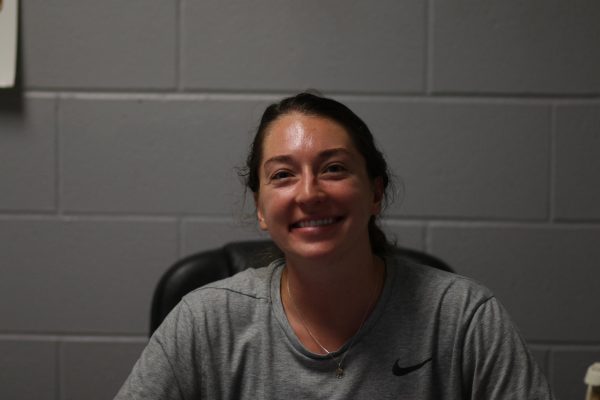
“I would say maturity-wise [is] very surprising, for sure, and still, also being kids and interested in those sensitive things. So I was surprised by that,” York said.
York’s favorite part of the job is the recovery process. Watching student-athletes put in the effort to return from injuries makes the work meaningful.
“My favorite part of the job is seeing athletes that were injured come back and their work ethic during recovery,” York said.
York admitted her career hasn’t been without challenges. Early on, she had to learn unexpected lessons.
“At the very beginning, as an athletic trainer, I wasn’t great at talking to coaches, and I didn’t think that that would be such a big part of the job,” York said. “Communicating with coaches about injuries and being clear on who can do what. So that was one thing I had to learn.”
“It was also really nice getting here and seeing how much [LASA students] pour into [their] studies and how important school is for them.”
– Chelsea York, Athletic Trainer
The other challenge came from her own background as an athlete. Her old habits as an athlete did not translate well once she became a trainer.
“I was always told ‘play through pain’ and ‘don’t come out or say anything unless something’s really bad’,” York said. “So I kind of tried to force that mentality on athletes in the beginning without realizing that these kids are really hurt, like they do need a couple weeks to come back. That kind of took an adjustment.”
She also noticed the unique challenges of training high school athletes compared to college players. While college athletes treat their sport like a full-time job, high schoolers often have to juggle academics, sports, and more.
“Collegiate setting, that’s their whole life,” York said. “You guys have so much on your plate and you’re going home and having five hours of homework that you can’t get to rehab or can’t do the stuff that you have at home. So I’d say that is a tough part of the job. I usually try to work with them about their schedule.”
Even more difficult are the demands on her time. The days are long, and the sport medicine field itself does not get much recognition.
“The hardest part is long hours for sure, we’re here all day, every day, and then just athletic training in general. It’s not a very respectable field,” York said.
Despite those challenges, York said she loves her new role at LASA. Though she might one day consider teaching, for now she’s focused on her high school student-athletes.
“The only other setting that I think I would pivot to is teaching athletic training at the university [level],” York said. “I love the teaching side of athletic training, and I think teaching at that level, where it’s in a Master’s course and they’re about to be athletic trainers themselves, that’s what I could see myself doing as well.”
Through injuries, recovery, and every comeback in between, LASA athletes can count on Chelsea York to be there.