

Every issue, the LASA Liberator sends a reporter into the field to try a new sport and write about their experiences.
When I was a kid, my dad taught me proper softball hitting form: square your shoulders, bend your knees, place the bat above your shoulder, and swing through the ball. I then proceeded to quit softball after one season. I hadn’t picked it up since, until recently, when I got a chance to go to LASA softball captain’s practice.
It was drizzling a bit the day I came, but that didn’t dissuade the girls from practice. I walked into the dugout a few minutes early and picked up a conversation with returning player Mary Snyder. She told me that the captain’s practice was a great place to get ready before the season started. She also mentioned that she was looking forward to the spring and district play and to the team lock-in, which last year was something she really enjoyed.
When practice got started, the girls all grabbed their gloves and ran a lap around the field, followed by some light stretches while talking about what they were going to do over Thanksgiving break. They laughed together, making fun of captain Lorena Edwards for saying she was looking forward to studying AP U.S. History. After stretching, everyone paired up, longtime players moving a bit farther away while Mary stayed to help the new players, myself included.
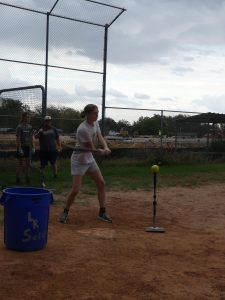
often to prepare for games. (Lily Antony)
She walked us through the simple throwing drill they were working on, offering tips on how to follow through and when to let go. “Pretend you’re ‘stuck in the mud,” Mary said. She then showed us the proper position to stand in while she bent her wrist backward, and then flicked her hand forward, tossing the ball towards the freshman around ten steps away. She explained how we should imagine there were “eyes in the pocket” (the palm of the glove), and these eyes should watch the ball the whole way through. When I got a turn, she showed me the motion again, and I was delighted when I managed to make it to the other girl.
After throwing, they started on a drill called “around the horn,” where they’d throw it as fast as they could around the diamond to each of the players standing on the different bases, starting over if they made a mistake. Lorena told me that this was one of many drills they would use to practice their throwing — others included diamond throwing, or infield/outfield drills. Sophomore Zoe Roberts told me that she used this drill, and others at captain’s practice, to “build love for the sport,” and the team community that she says “is really impressive.”
This community was evident as practice went on into a batting/hitting drill. They placed the ball on a stand, and then captain Julia Penzur hit it off to third or first base, where the player there would catch it and throw it across the field. Through each hit, all the girls cheered each other on, and if a mistake was made, they’d teasingly call out that it was all due to a “new glove.” Mary stood behind Julia and collected balls, and after every round she’d call out, “Good work, babe.” When I asked if I could try hitting, Mary quickly showed me the proper hitting form, the squaring of the shoulders, the bent knees, the follow-through, adding that I should really try to extend my arms. Then, when I got the ball to third base, I too earned a “good job.”
Everyone I spoke to told me that they were excited for the season, but also excited for their team community. I could see why. Even in just one captain’s practice, there was so much support. They held each other up and made things simple for me and the other newcomers, slowly and gently walking us through the motions to make sure we were set up to succeed.